






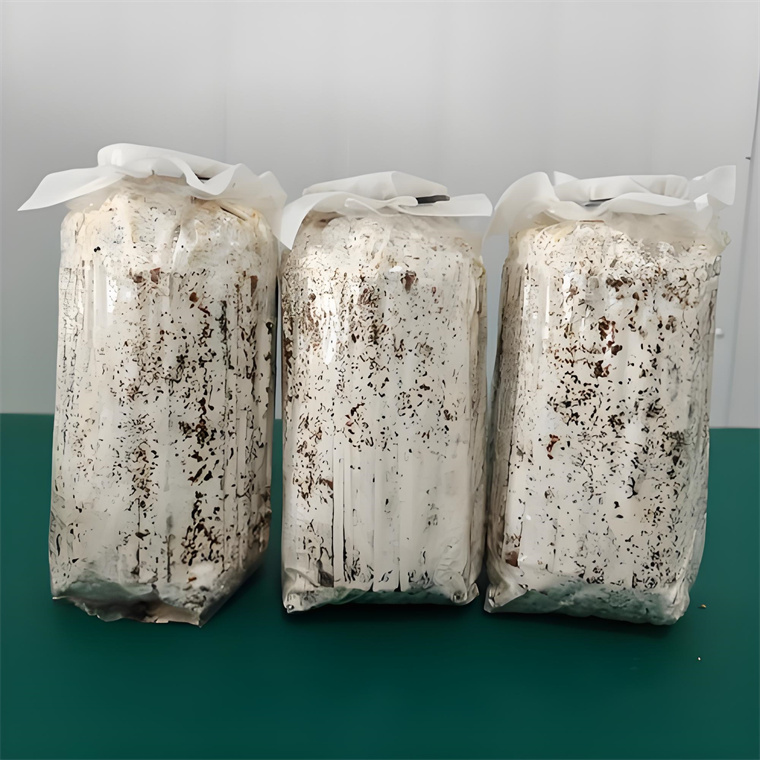
1. Concept and Advantages of Stick Spawn
Stick spawn is a tertiary edible mushroom spawn made from bamboo sticks, wooden sticks or popsicle sticks, mainly used for oyster mushroom and wood ear mushroom cultivation. It has prominent advantages in mushroom production:
High inoculation efficiency: The inoculation operation is simple and fast with rapid mycelial germination.
Low contamination risk: Only a small opening is required to insert the stick into the medium center, avoiding full exposure of the cultivation bag and shortening medium exposure time.
Fast mycelial colonization: Sticks penetrate deep into the medium to realize multi-point germination at the top, middle and bottom, forming a three-dimensional radial mycelial growth. It shortens the bag/bottle colonization period by 5–7 days and improves the uniformity of mushroom fruiting.
Stick spawn production requires professional skills and generally adopts high-pressure sterilization treatment.
2. Production Steps for Oyster Mushroom Stick Spawn
The complete production flow: Wood material selection → Stick soaking and boiling → Auxiliary material preparation → Filling and bagging → Sterilization → Inoculation → Incubation
2.1 Wood Material Selection
Applicable materials: Poplar, mulberry, oak, linden, willow and other mushroom-cultivation-suitable woods. Poplar is preferred for its low cost. Disposable chopsticks and popsicle sticks are also available.
Specification: Standard stick size is 12–15 cm long, 0.5–0.7 cm wide and thick, which can be adjusted according to cultivation bag size.
2.2 Stick Soaking and Boiling
Soaking method: Submerge bundled sticks in pH 10 lime water with 10 cm overlying water. Soak for 24 hours at normal temperature or 36 hours in cold seasons to reach 60% moisture content. Sticks are fully saturated when no dry white core exists after splitting, then drain thoroughly.
Boiling method: Prepare nutrient solution (per 100 kg water: 1 kg sucrose + 0.3 kg potassium dihydrogen phosphate + 0.15 kg magnesium sulfate). Boil sticks for 30–40 minutes until no internal white core appears, then take out and drain.
2.3 Auxiliary Material Preparation
Function: Fill gaps between sticks and supply nutrients for mycelial growth, with an optimal addition rate of 30%.
Formula: 78% cottonseed hulls (or sawdust), 20% wheat bran, 1% gypsum, 1% adjustable lime.
Parameters: Adjust mixture to 60%–65% moisture content and pH 8.0–9.0. Mix well with sticks to ensure uniform adhesion on stick surfaces.
2.4 Bagging
Bag specification: 17 cm × 33 cm polypropylene bags, thickness 0.005–0.007 cm (not thinner than 0.005 cm).
Operation: Place a 2 cm auxiliary material layer at the bag bottom, fill with about 200 coated sticks, compact gaps on both sides, and cover the top with a thin material layer to form a protective "bridge". Fill the bag to 70%–80% capacity, install collar and cotton/plastic plug. Double-layer bags can be used to prevent contamination.
2.5 Sterilization
Sterilization parameters: Atmospheric sterilization at 100°C for 15 hours; high-pressure sterilization at 126°C for 2 hours.
Quality judgment: White exudate from bags indicates complete sterilization; yellow exudate means incomplete sterilization, which easily causes Trichoderma (green mold) infection.
2.6 Inoculation
Perform aseptic inoculation when the substrate temperature drops below 25°C. One tube of master culture can inoculate five cultivation bags.
2.7 Incubation
Incubate in dark environment at 20–25°C, with 40%–50% relative humidity and proper ventilation. The breathable stick medium accelerates mycelial growth, shortening the incubation period by 5–7 days compared with conventional spawn.
3. Application of Mature Stick Spawn
Maturation requirement: Do not use spawn immediately after full colonization. A 10-day after-ripening period is necessary to ensure mycelium fully penetrate the sticks, ensuring high survival rate and fast colonization.
Common mistake: Early use of immature spawn will lead to mycelial death and germination failure.
Inoculation operation: Disinfect the cultivation bag surface with alcohol cotton, remove the neck ring and old mycelial crust, insert mature stick spawn into the bag opening, seal the top with a layer of solid spawn, and close the lid tightly.


 Send Email
 WhatsApp